


✓ Full Hub access free for 90 days
Safeguarding Children with Additional Needs
Recognising concerns, understanding communication
and protecting children whose additional needs
may make safeguarding less accessible.
Every child has the right to feel safe,
be heard and receive appropriate protection.
Children with additional needs can face
additional barriers to recognising unsafe
situations, communicating concerns or
accessing support.
This practical online course helps
practitioners recognise safeguarding
concerns, understand communication
beyond speech, challenge assumptions
and respond appropriately.
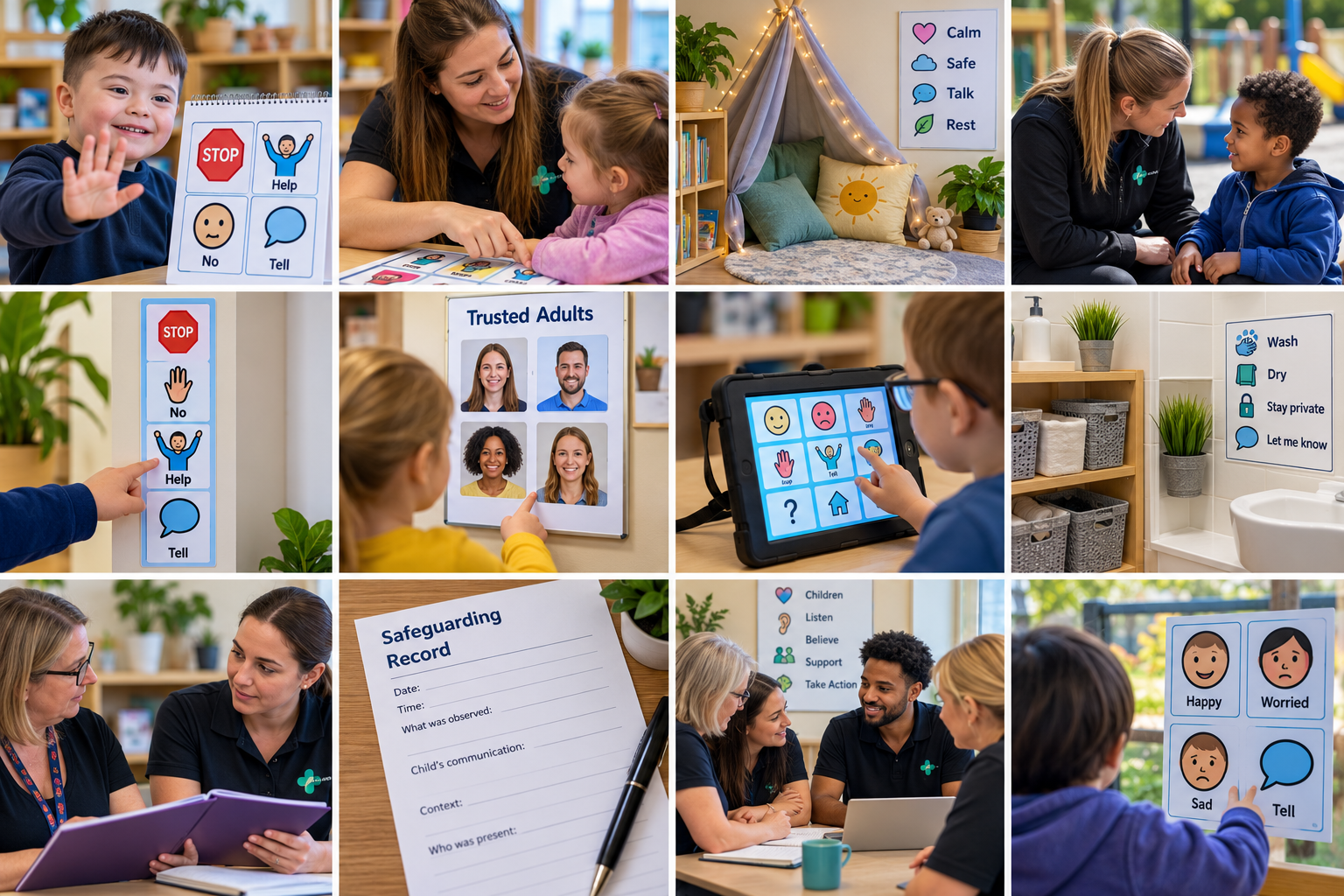
Through realistic scenarios, videos,
interactive activities and practical
resources, learners explore how
to make safeguarding more accessible,
inclusive and child-centred.
Flexible online learning
Interactive course content
CPD Group accredited
On successful completion
Officially Accredited by The CPD Group
Safeguarding Children with Additional Needs
has been independently reviewed and
approved by The CPD Group as an
accredited continuing professional
development activity.
The course provides
four hours of structured CPD learning
and combines professional safeguarding
knowledge with realistic childcare
scenarios and interactive learning.
On successful completion, learners
receive a certificate confirming
an activity carrying
4 CPD points.
Suitable for Early Years &
School-Age Childcare Professionals
This UK-wide course supports professionals
working with children who may have
additional developmental, communication,
sensory, learning or support needs.
No previous specialist safeguarding qualification
is required. The course develops professional
awareness and reflective practice but does
not replace designated safeguarding lead training.
Building Confidence in Accessible Safeguarding Practice
By the end of the course, learners will be able to:
Explain why children with additional needs
may face barriers to recognising,
communicating or reporting concerns.
Use an individual child’s usual communication,
behaviour and presentation as a baseline.
Recognise AAC, signs, symbols, gestures,
eye gaze and behaviour as communication.
Listen appropriately, avoid leading questions
and respond without investigating independently.
Recognise diagnostic overshadowing
and challenge assumptions that may
cause safeguarding concerns to be missed.
Understand dignity, dependency,
communication and professional boundaries.
Help children understand messages
such as NO, STOP, HELP, HURT and TELL.
Identify concerns involving peers,
bullying, coercion, online contact
and community situations.
Separate factual observations from
interpretations and follow procedures.
Review communication, environments,
staff knowledge and safeguarding systems.
What’s Covered in the 12 Lessons?
01 — Safeguarding When a Child’s Needs Are Different
Understanding safeguarding barriers and
why individualised practice matters.
02 — Know the Child: Baselines, Changes &
Professional Curiosity
Recognising meaningful changes in
the child’s communication and presentation.
Understanding AAC, gestures, symbols,
eye gaze and behaviour as communication.
04 — When a Child Communicates a Safeguarding Concern
Responding calmly, listening appropriately
and avoiding leading questions.
05 — The Danger of Assumptions:
Diagnostic Overshadowing
Challenging assumptions and recognising
concerns that might otherwise be dismissed.
06 — Personal Care, Dependency &
Professional Boundaries
Dignity, communication, refusal,
dependency and safer personal-care practice.
07 — Helping Children Understand Safety
Accessible safety education,
body boundaries and trusted adults.
08 — Risks Beyond Adult-to-Child Abuse
Peer relationships, bullying,
coercion, online and community risks.
Factual safeguarding records,
information sharing and reporting.
10 — Creating Accessible Safeguarding Practice
Improving staff confidence,
environments, communication and procedures.
Eight downloadable practitioner tools
and useful UK safeguarding guidance.
12 — Summary & Final Assessment
Course review, interactive readiness check,
final assessment and learner evaluation.
Safeguarding Training Built Around Real Practice
Safeguarding requires more than simply
knowing a policy. Practitioners need
confidence in recognising concerns
and responding appropriately.
Explore practical situations involving
children with different communication
and support needs.
Practise distinguishing observation
from assumption and recognising
when concerns require escalation.
Consider how safeguarding works
within your setting and identify improvements.
Learn through videos, visual examples
and practical downloadable tools.
Your Accessible Safeguarding Practice Toolkit
Learners receive access to
8 downloadable First Stop Safety Training resources,
designed to support practical safeguarding,
professional reflection and whole-setting improvement.
These resources are provided within the
online course as part of the learner’s
professional development materials.
The full worksheets, checklists, guides
and downloadable materials are provided
within the course for enrolled learners.
An Important Principle:
Communication Is Not Limited to Spoken Words
A child may communicate discomfort,
distress or a safeguarding concern
through AAC, symbols, signs, gestures,
behaviour or changes in presentation.
Practitioners should not assume that
a child cannot communicate concerns
because they use few or no spoken words.
The course reinforces the safeguarding approach:
Notice, Listen, Record, Share/Report
and Follow Procedure.
Complete Your Training and Receive Your Certificate
The course concludes with an interactive
readiness check and an online assessment.
Questions assess communication,
professional curiosity, personal care,
recording, reporting and applying
safeguarding knowledge to realistic situations.
Assessment questions
Pass mark — 16 out of 20
Assessment attempts allowed
Learners can revisit course content
and retake the assessment if they
do not achieve the required pass mark.
A completion certificate is awarded
following successful completion
of the course and final assessment.
CPD Group Accredited · 4 CPD Points
Ready to Begin Your Safeguarding Training?
Access the course through the
First Stop online learning platform
and complete all 12 lessons
at your own pace.
Learn through realistic scenarios,
narrated videos, interactive activities
and professional reflection.
First Stop Childcare Learning Hub
Give Your Whole Team Access
to Online Childcare CPD
Safeguarding Children with Additional Needs
is available through the First Stop
Childcare Learning Hub, alongside
a growing range of professional
development courses.
Settings benefit from unlimited
staff access, certificates,
learner progress tracking
and manager reporting.
New settings can explore the
Learning Hub with a
90-day free trial.
✓ Unlimited Staff per Setting · 90-Day Free Trial
About this training:
This course has been developed by
First Stop Safety Training Ltd
and accredited by The CPD Group
as a four-point CPD activity.
It supports professional safeguarding
knowledge, awareness and reflective
practice but does not replace
organisational safeguarding policies,
local child-protection procedures,
designated safeguarding lead qualifications
or specialist safeguarding training
required for an individual’s role.