
Over the past year, we’ve had a growing number of customers, particularly nurseries and early years settings asking about LifeVac and similar anti-choking devices. These products are heavily marketed online and on social media, often with powerful videos showing “lives being saved”.
So the question we’re being asked is:
“Should we have one?”
“Do you recommend them?”
As a first aid training provider in Scotland, and as FAIB aligned instructors, the answer is not as simple as yes or no.
What is a LifeVac?
LifeVac is a portable suction device designed to remove a foreign body from the airway of a choking person. It works by placing a mask over the mouth and nose and pulling a plunger to create suction.
There are several similar products on the market, often described as:
- Anti-choking devices
- Airway clearance devices
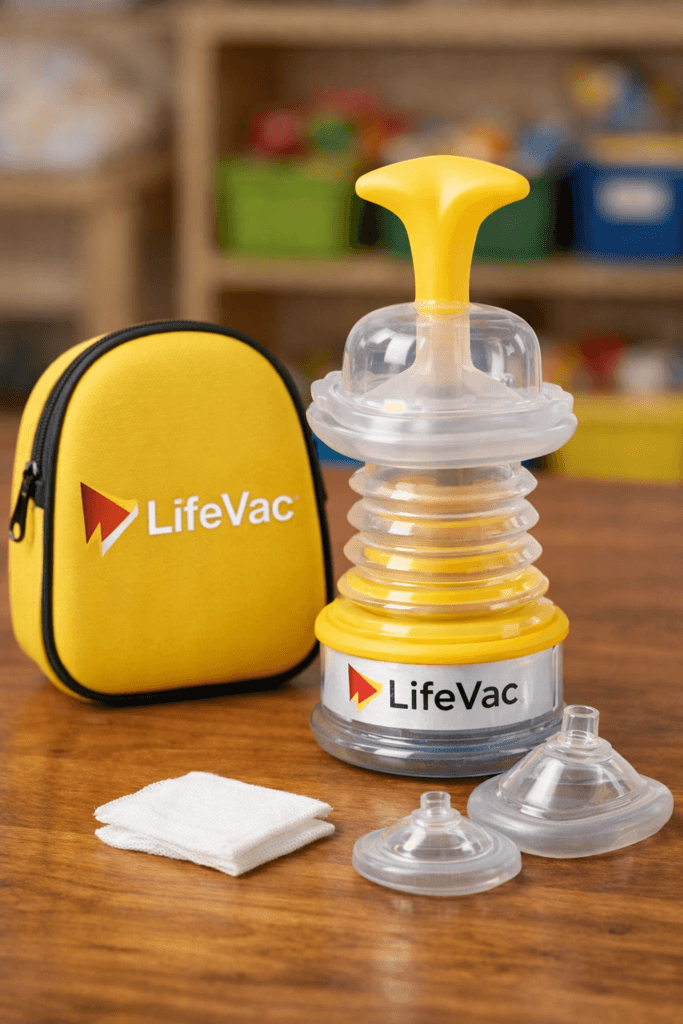
They are sold for use on adults, children and infants.
Why Are People Interested in Them?
The appeal is obvious:
- They look simple to use
- They are marketed as a “last resort”
- They claim to work when back blows and abdominal thrusts fail
- They are widely promoted in childcare settings
For nurseries and parents, especially, the idea of “another tool” can feel reassuring.
The Problem: Lack of Evidence
At present, there is no high-quality, independent clinical evidence proving that LifeVac or similar devices are safe and effective.
Most of the “success stories” come from:
- The manufacturers themselves
- Social media testimonials
- Self-reported cases
These are not the same as peer-reviewed medical evidence.
Major resuscitation bodies such as:
- Resuscitation Council UK
- European Resuscitation Council
- ILCOR (International Liaison Committee on Resuscitation)
do not include these devices in their choking guidelines.
FAIB Position (and Our Position)
As FAIB-aligned first aiders and instructors, we are required to teach evidence-based practice only.
That means:
- Back blows
- Abdominal thrusts (or chest thrusts where appropriate)
- CPR if the casualty becomes unresponsive
We are not allowed to recommend or train on devices that fall outside recognised UK guidelines.
So when people ask:
“Do you recommend LifeVac?”
Our professional answer has to be:
No, not as a first aid intervention.
Potential Risks
Another concern is that these devices may:
- Delay proper first aid
- Give false confidence
- Be used incorrectly
- Cause harm if misapplied
In choking emergencies, time is critical. Anything that delays immediate, proven techniques can reduce survival chances.
Should Settings Buy Them Anyway?
This is where it becomes a policy and insurance decision, not a first aid one.
Some organisations choose to purchase them as:
- A last resort
- A reassurance tool
- A non-clinical decision
But it’s important to understand:
- They are not part of UK first aid standards
- They should never replace training
- Staff must still follow Resuscitation Council guidance first
Having one does not remove the need for:
- Competent staff
- Regular training
- Proper risk management
Our Professional View
From a training and safety perspective: Good first aid skills save lives. Devices do not replace competence.
If staff can confidently perform:
- Effective back blows
- Correct thrusts
- Calm casualty management
Then they already have the most reliable tools available.
Final Thoughts for Nurseries and Schools
We completely understand why settings ask about LifeVac – especially when working with young children. But at this time:
- There is no strong evidence to support their routine use
- They are not recommended by UK first aid authorities
- They should not be relied upon instead of proper training
The best protection against choking remains:
- High-quality first aid training
- Regular refreshers
- Good supervision and food policies