
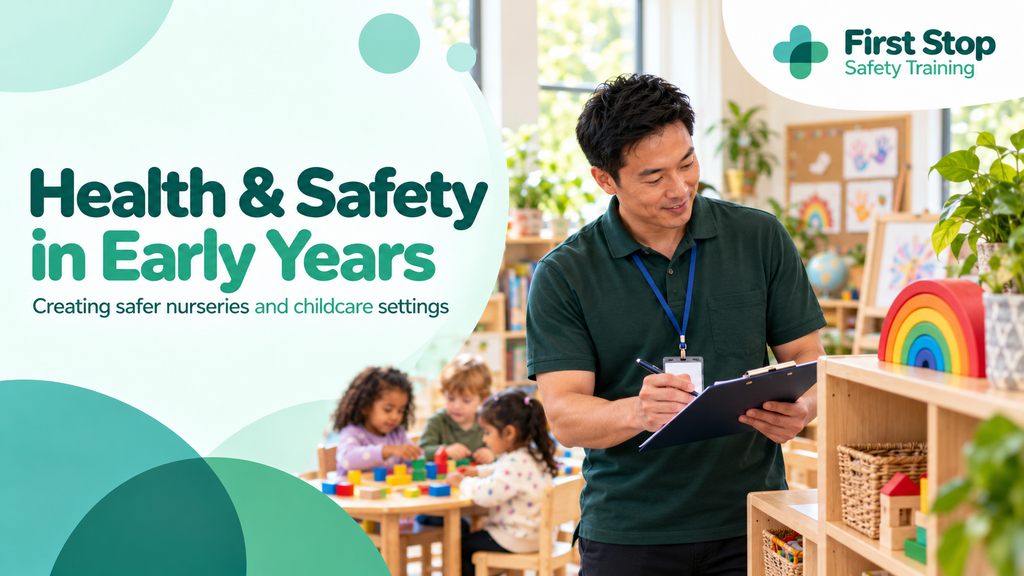
Health and safety in Early Years is about much more than completing risk assessments or keeping a folder of policies up to date.
In a nursery, preschool, childminding service or other childcare setting, health and safety is happening constantly.
It is present when a practitioner checks the outdoor area before children go outside.
It is present when a spill is cleaned up quickly.
It is present when staff count children before leaving for an outing.
It is present when equipment is checked, medication is stored safely, doors are secured and practitioners notice that something does not look quite right.
Good health and safety practice should not feel separate from caring for children.
It should be built into everyday decisions.
This guide explores some of the main health and safety considerations in Early Years settings and looks at practical ways managers and practitioners can create environments that are both safe and stimulating.
What Does Health and Safety Mean in Early Years?
Health and safety in Early Years means protecting children, staff, families and visitors from avoidable harm while allowing children to learn, explore and develop.
That balance is important.
The aim is not to remove every possible risk.
Children need opportunities to climb, run, explore, experiment and develop independence.
The Care Inspectorate recognises that Early Learning and Childcare environments should provide children with an appropriate balance of safety, independence, challenge, new experiences and support. Its guidance encourages practitioners to manage risk sensibly rather than simply removing opportunities for exploration. hub.careinspectorate.com
A well-managed Early Years setting therefore asks two questions:
What could cause harm?
And:
How can we reduce that risk without unnecessarily limiting children’s learning?
Health and Safety Is Everyone’s Responsibility
Managers have important responsibilities for putting health and safety arrangements in place, but safe practice cannot sit with one person.
Practitioners are often the first people to notice hazards.
A loose piece of outdoor equipment.
A damaged toy.
A wet floor.
A gate that has not closed properly.
A trailing cable.
A child behaving unusually.
A cleaning product left somewhere it should not be.
A safe setting depends on staff feeling confident enough to notice concerns and take action.
The Health and Safety Executive explains that effective health and safety management is an ongoing process involving planning, organisation, control, monitoring and review. HSE also recommends involving workers because practitioners often have valuable knowledge about the risks they encounter during everyday work. HSE
That means health and safety should be part of the culture of the setting rather than something discussed only when an inspection is approaching.
Risk Assessments Should Be Useful
Risk assessment is one of the foundations of good health and safety management.
But a risk assessment is only useful if it reflects what actually happens in the setting.
A lengthy document that nobody reads is far less valuable than a clear assessment that practitioners understand and use.
A practical risk assessment should consider:
- what the hazard is
- who could be harmed
- how they could be harmed
- what controls are already in place
- whether further action is required
- who is responsible for that action
- when the assessment should be reviewed
The HSE emphasises that risk assessment is about taking sensible measures to control real risks rather than generating unnecessary paperwork. HSE
In Early Years, assessments may cover areas such as:
- indoor play spaces
- outdoor areas
- outings
- sleep environments
- kitchens and food preparation
- changing areas
- medication
- cleaning products
- play equipment
- manual handling
- fire safety
- slips and trips
- arrival and collection procedures
The key is that staff understand the controls, not simply that a form has been completed.
Risk Assessment and Risk-Benefit Assessment Are Not the Same Thing
Early Years settings also need to think about the benefits of appropriate risk.
Imagine children climbing on a low tree trunk outdoors.
There is a possibility that someone could slip.
But children are also developing:
- balance
- coordination
- confidence
- judgement
- resilience
- physical strength
The answer is not automatically to remove the tree trunk.
Instead, practitioners can ask:
Is the activity suitable for these children?
Is the environment appropriate?
Do children understand the boundaries?
Is supervision adequate?
Can we reduce unnecessary hazards while preserving the learning opportunity?
The Care Inspectorate has specifically promoted this kind of risk-benefit thinking, recognising that children need opportunities to experience challenge and develop their ability to make safe decisions. hub.careinspectorate.com
Good Early Years health and safety is therefore not about creating a risk-free childhood.
It is about managing risk intelligently.
Slips, Trips and Falls
Slips and trips may sound simple, but they are one of the most common causes of workplace injury.
Early Years environments create particular challenges.
There may be:
- toys on floors
- water from messy play
- food and drink spills
- wet outdoor clothing
- bags near entrances
- uneven outdoor surfaces
- small furniture
- trailing resources
- busy transition periods
HSE guidance notes that slips and trips are among the most common workplace accidents and that straightforward controls can often prevent them. HSE
Practical controls in an Early Years setting may include:
- cleaning spills promptly
- keeping walkways clear
- checking flooring
- using appropriate entrance mats
- maintaining good lighting
- storing resources properly
- reporting damaged flooring
- avoiding overcrowding around doorways
Children’s play environments will never be completely tidy.
But there is a difference between purposeful play and avoidable hazards.
Keeping Children Accounted For
One of the most serious safety risks in childcare is a child leaving a setting unnoticed or being left behind during a transition.
This is why counting children cannot become a mechanical task.
Practitioners need to know:
- how many children are present
- where they are
- who is responsible for each group
- whether numbers have changed
- whether everyone has been accounted for during movement
The Care Inspectorate’s SIMOA approach encourages staff to Safe, Inspect, Monitor, Observe and Act, particularly around gates, doors, outings, transitions and collection times. hub.careinspectorate.com
That might mean checking children:
- before leaving a room
- after entering another space
- before boarding transport
- after leaving transport
- at outdoor play
- before returning indoors
- during outings
- at handover points
A headcount should tell you more than a number.
Staff should know which children are present.
Doors, Gates and Perimeters
A gate only protects children if it works.
Settings should routinely check:
- entrance doors
- garden gates
- perimeter fencing
- access controls
- locks
- door closers
- external play areas
This is especially important during busy times.
Arrival and collection periods can create distractions.
Parents are entering and leaving.
Children may move between rooms.
Staff may be speaking to families.
That is exactly when systems need to remain reliable.
If a safety measure depends entirely on someone remembering to do something every time, managers should ask whether a stronger control could be introduced.
Safe Indoor Environments
The indoor environment changes constantly.
Children move furniture.
Resources are introduced.
Equipment gets damaged.
Activities create new hazards.
A room that was safe at 8am may look very different by lunchtime.
Practitioners should develop the habit of scanning their environment throughout the day.
Ask:
Is anything broken?
Is anything blocking an exit?
Has a spill occurred?
Has furniture moved?
Is anything now within children’s reach that should not be?
Is equipment being used differently from how we expected?
Is the room becoming overcrowded?
Health and safety is often about noticing small changes before they become incidents.
Outdoor Safety
Outdoor play brings huge benefits.
Children develop physical skills, confidence, curiosity and independence.
But outdoor spaces also change more quickly than indoor environments.
Weather can create:
- slippery surfaces
- ice
- standing water
- damaged ground
- falling branches
- heat exposure
- sun exposure
Outdoor areas should therefore be checked regularly.
Settings might consider:
- fencing and boundaries
- broken equipment
- sharp objects
- plants
- animal contamination
- trip hazards
- loose surfaces
- water hazards
- weather conditions
The goal is not to make outdoor play completely predictable.
It is to identify hazards that children cannot reasonably be expected to manage themselves.
Equipment Safety
Children’s equipment should be suitable, maintained and used appropriately.
This includes:
- toys
- climbing equipment
- tables and chairs
- cots
- changing equipment
- outdoor resources
- storage units
- wheeled toys
- electrical equipment
Practitioners should know what to do if equipment becomes damaged.
If a chair becomes unstable or a toy develops a sharp edge, the safest response is generally to remove it from use until it can be repaired or replaced.
“Someone else will deal with it later” is how minor hazards can remain in circulation.
COSHH and Cleaning Products
Early Years settings use many substances that children should not access.
These may include:
- disinfectants
- cleaning sprays
- dishwasher products
- laundry products
- handwashing chemicals
- art materials
- maintenance products
Some may fall under the Control of Substances Hazardous to Health Regulations.
Staff should understand:
- what products they use
- where safety information is kept
- how products should be stored
- whether products require dilution
- what PPE may be needed
- what to do if exposure occurs
Cleaning products should not simply be moved “out of sight”.
They need appropriate storage and control.
Infection Prevention
Young children share toys, touch surfaces, put objects in their mouths and interact closely with one another.
That makes infection prevention an everyday part of health and safety.
Good practice includes:
- effective hand hygiene
- appropriate cleaning
- safe nappy-changing procedures
- correct use of PPE where required
- managing bodily fluids
- safe waste disposal
- understanding exclusion guidance
- knowing what to do during outbreaks
Health and safety works best when these routines become normal practice rather than something introduced only when illness is circulating.
Medication Safety
Medication can create significant risks if procedures are unclear.
Settings should have robust arrangements for:
- parental consent
- storage
- expiry dates
- dosage
- administration records
- emergency medication
- refrigeration where required
- outings
- errors or missed doses
Staff should know which children require medication and who is authorised and competent to administer it.
Medication should never rely on memory alone.
Manual Handling and Staff Safety
Health and safety protects staff as well as children.
Early Years work can be physically demanding.
Practitioners may:
- lift children
- move furniture
- carry equipment
- sit on low chairs
- work at floor level
- reach into cots
- move outdoor resources
Repeated awkward movements can contribute to musculoskeletal problems.
Where possible, settings should reduce unnecessary lifting and adapt environments to make tasks easier.
For a deeper look at this area, staff can also read our guide to manual handling in Early Years or complete specific manual handling training.
Fire Safety
Every setting needs to be prepared for an emergency evacuation.
That means staff should understand:
- alarm procedures
- escape routes
- assembly points
- how children are accounted for
- responsibilities during evacuation
- arrangements for babies and children requiring additional support
- what happens during sleep periods
- how visitors are managed
Fire drills should help staff identify weaknesses.
If an evacuation reveals that a procedure does not work well, the drill has done its job.
The response should be to improve the procedure rather than simply record that the drill took place.
First Aid
Accidents can still happen even in well-managed settings.
That is why Early Years settings need appropriate first aid arrangements.
Staff should know:
- who the qualified first aiders are
- where first aid equipment is kept
- how accidents are recorded
- when parents should be informed
- when emergency services are required
- how first aid arrangements work during outings
Health and safety is about prevention, but it is also about being prepared when prevention is not enough.
Reporting Accidents and Near Misses
Near misses are valuable.
Imagine a child nearly trips over a damaged floor edge but catches themselves.
Nobody is injured.
It would be easy to move on.
But the next child might not catch themselves.
Near-miss reporting gives settings an opportunity to act before someone gets hurt.
A useful safety culture encourages staff to report concerns without worrying that they will be blamed for raising them.
Managers should look for patterns.
If similar incidents keep happening, the underlying system may need to change.
Health and Safety During Outings
Outings introduce different risks.
Practitioners may need to consider:
- staffing
- headcounts
- transport
- road safety
- medical needs
- emergency contacts
- toilets
- weather
- missing child procedures
- public spaces
The Care Inspectorate has highlighted transitions and outings as areas where children’s safety can be particularly vulnerable if staff do not understand responsibilities clearly. hub.careinspectorate.com
Preparation matters.
Staff should know what they will do if plans change unexpectedly.
Safe Collection and Handover
The end of the day can be one of the busiest periods in a setting.
Practitioners may be:
- speaking to parents
- preparing belongings
- completing handovers
- supervising children
- answering questions
- opening secure doors
Collection arrangements need to remain controlled even when staff are busy.
Settings should have clear procedures covering:
- authorised collectors
- passwords where used
- changes to collection arrangements
- court orders or restrictions
- late collection
- unfamiliar adults
Never assume another staff member has checked.
Health and Safety Should Not Depend on One Manager
A strong setting does not become unsafe when the manager leaves the building.
Every practitioner should understand the basics of the setting’s procedures.
That includes new staff, apprentices, temporary staff and relief workers.
Induction should therefore cover health and safety information that is specific to the setting.
For example:
Where are the fire exits?
Where is medication stored?
Who is the first aider?
How do we report an accident?
What happens if a child goes missing?
Where are cleaning chemicals stored?
What do we do if equipment becomes damaged?
Generic training provides knowledge.
Setting-specific induction tells staff how that knowledge applies where they actually work.
Create a Culture Where People Speak Up
Imagine a new practitioner notices that an outdoor gate does not always latch properly.
They mention it to a colleague.
The response is:
“It’s always been like that.”
That sentence should concern managers.
Longstanding practices are not automatically safe practices.
A healthy safety culture allows practitioners to ask:
Why do we do it this way?
Could this be safer?
Has anything changed?
Does this procedure still work?
HSE guidance encourages organisations to involve workers and continually check whether existing controls remain effective. HSE
A Simple Health and Safety Walkthrough for Early Years Managers
Walk through your setting as though you have never seen it before.
Look at:
Entrances
Are doors and gates secure?
Floors
Are there damaged areas, clutter or slip hazards?
Storage
Can children access anything unsafe?
Toys
Is anything broken?
Furniture
Is anything unstable or poorly positioned?
Fire Exits
Are routes clear?
Outdoor Areas
Has anything changed since the previous check?
Cleaning Products
Are they securely stored and correctly labelled?
Medication
Is it secure, in date and accessible when needed?
Staff
Do they know what to do if something goes wrong?
Children
Can staff account for every child?
One of the best questions managers can ask is:
“If this caused an incident tomorrow, would we look back and realise we already knew about the problem?”
If the answer is yes, act now.
Health and Safety Training for Early Years Practitioners
Good health and safety training should help practitioners make sensible decisions rather than simply memorise rules.
Our Health and Safety in Early Years course is designed specifically around the types of risks staff encounter in nurseries and childcare settings.
The course explores practical areas such as:
- recognising hazards
- understanding responsibilities
- risk assessment
- slips, trips and falls
- safe environments
- equipment
- fire safety
- manual handling
- hazardous substances
- accident reporting
- everyday safety culture
The course is CPD Group accredited and provides 2 CPD credits. Our Learning Hub currently lists Health and Safety in Early Years as one of its accredited courses. First Stop Safety Training
View the Health and Safety in Early Years course
I would just check that individual course URL before you publish this article, because the course is clearly listed on your Learning Hub but the standalone sales page is not currently appearing in Google’s index for me.
Health and Safety Training for Your Whole Team
Health and Safety in Early Years is also included within the First Stop Learning Hub.
The Learning Hub provides nurseries and childcare settings with access to a growing library of CPD-accredited courses through one platform, including areas such as safeguarding, health and safety, child development, wellbeing and leadership. First Stop Safety Training
For settings looking to train a whole team rather than purchase courses individually, the Hub provides unlimited staff access alongside progress monitoring and digital certificates.
You can also read our Introducing the First Stop CPD Hub – CPD Training for Early Years Professionals article to learn more about how the platform works. First Stop Safety Training
Explore the First Stop Learning Hub
Frequently Asked Questions About Health and Safety in Early Years
What is health and safety in Early Years?
Health and safety in Early Years involves identifying and managing risks that could affect children, staff or visitors while still providing children with appropriate opportunities to play, explore and learn.
Who is responsible for health and safety in a nursery?
Employers and providers have legal responsibilities for health and safety arrangements, but practitioners also play an important role in following procedures, reporting hazards and working safely.
Do nurseries need risk assessments?
Yes.
Health and safety risks need to be assessed and controlled.
Risk assessments should reflect the actual activities, environments and people within the setting rather than being treated as generic paperwork.
Does health and safety mean removing all risk from play?
No.
Children benefit from appropriate challenge and managed risk.
The aim is to control unnecessary or serious hazards while still allowing children opportunities to develop confidence, independence and judgement.
What are common health and safety hazards in Early Years?
Common examples include:
- slips and trips
- unsafe equipment
- unsecured doors or gates
- hazardous substances
- manual handling
- infection risks
- medication errors
- fire risks
- outdoor hazards
- poor supervision
- unsafe storage
The risks will vary depending on the individual setting.
How often should health and safety risk assessments be reviewed?
There is no single review interval appropriate for every situation.
Assessments should be reviewed when circumstances change, after incidents or near misses, when new equipment or activities are introduced and whenever there is reason to believe the existing controls may no longer be adequate.
Should all nursery staff receive health and safety training?
Staff need sufficient information, instruction and training to carry out their work safely.
A manager’s responsibilities will differ from those of a new practitioner, but everyone should understand the health and safety procedures relevant to their role.
Health and Safety Is About What Happens Every Day
Strong health and safety practice rarely comes from one dramatic action.
It comes from hundreds of small decisions.
A practitioner notices a spill and cleans it.
Someone checks the gate.
A damaged toy is removed.
A manager acts on a near miss.
A member of staff questions a procedure that no longer works.
Children are counted properly during a transition.
A new practitioner receives a thorough induction.
These actions may seem ordinary.
That is exactly the point.
In a strong Early Years setting, safe practice should be ordinary.
It should be part of how the team works every day.