
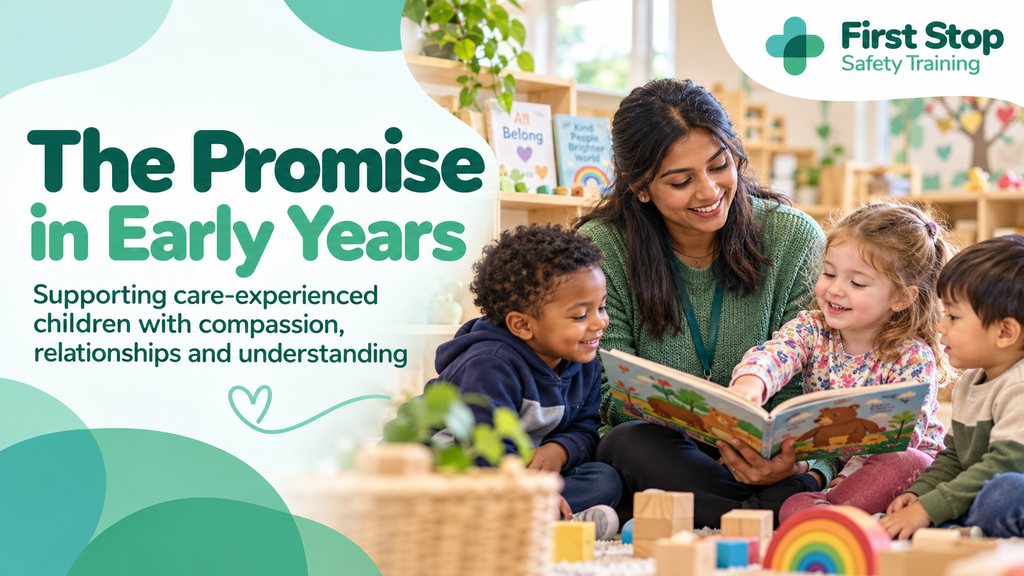
If you work with children in Scotland, you may already have heard people talking about The Promise.
You might have seen it referenced in Care Inspectorate guidance, local authority plans, staff training or discussions about care-experienced children and young people.
But what does Keeping the Promise actually mean for an Early Years practitioner?
Is it something that only applies to social workers and residential care?
Or should people working in nurseries, Early Learning and Childcare settings, childminding services and school-age childcare understand it too?
The answer is important.
The Promise is not simply about what happens once a child enters care. It is about changing how Scotland supports children and families, listening properly to the experiences of people with care experience, providing help earlier and creating services in which children feel loved, safe, respected and able to thrive.
For people working in Early Years, many of those principles connect directly with everyday practice.
What Is The Promise?
The Promise developed from Scotland’s Independent Care Review.
The Review took place between 2017 and 2020 and examined how Scotland cared for children, young people and families.
Crucially, it did not look only at policies and services.
It listened to the people who had actually experienced the care system.
According to Education Scotland’s information on The Promise, the Independent Care Review heard more than 5,500 experiences, with over half coming from children, young people and adults who had lived in care.
The findings resulted in a commitment that Scotland would change the way it supports children and families.
At its heart is a straightforward ambition:
Children should grow up loved, safe and respected, with the ability to realise their full potential.
That commitment became The Promise.
You can explore the national work and current developments directly through The Promise Scotland.
The Promise Isn’t Just About Children Living in Care
One of the biggest misconceptions is that The Promise matters only to professionals working directly within the care system.
It is much wider than that.
The Independent Care Review looked at what Scotland must do to support:
- children and young people
- families
- care-experienced people
- people on the edges of care
- the workforce supporting them
- the wider systems surrounding children and families
Early support is particularly important.
If families can access meaningful, compassionate support before difficulties escalate, some children may never need to enter the care system.
That means professionals throughout children’s services have a role.
An Early Years practitioner may be one of the people who knows a family best.
You see children regularly.
You speak to parents and carers.
You notice changes.
You build relationships.
You may recognise that something is becoming difficult long before another service becomes involved.
That makes Early Years part of the wider picture.
What Does Care Experienced Mean?
The phrase care experienced can include a wide range of childhood experiences.
It isn’t limited to children currently living in foster care.
A child or young person may have experience of:
- foster care
- kinship care
- residential care
- being looked after at home
- adoption following care
- other forms of state-supported care
Importantly, individuals may feel differently about terminology.
Some people strongly identify as care experienced.
Others do not want their experience of care to define them.
This matters because one of the recurring principles behind The Promise is that care experience should not result in stigma or children feeling different from their peers.
Practitioners therefore need to think not only about what support they provide, but about how that support feels to the child receiving it.
Why Does The Promise Matter in Early Years?
Imagine two children arriving at nursery.
One lives with their birth parents.
The other is currently living with a kinship carer following a difficult period within their family.
Should the second child automatically be treated differently?
Not necessarily.
They may require additional support, but good practice should avoid making them feel singled out, labelled or defined by their family circumstances.
The practitioner needs to see the child first.
That might mean understanding:
- the child’s relationships
- significant adults in their life
- changes they have experienced
- what helps them feel safe
- what may trigger distress
- how transitions affect them
- who should receive information
- how their story is discussed
- what information genuinely needs to be shared
This is where The Promise moves from national policy into everyday practice.
Relationships Matter
One of the strongest messages from The Promise is the importance of relationships.
Children do not experience services, policies or organisational structures in the abstract.
They experience people.
For a young child, their relationship with a familiar practitioner can provide consistency during a period when other parts of life may feel uncertain.
Think about a child whose home arrangements have recently changed.
They may have:
- moved house
- changed caregiver
- experienced separation
- lost familiar routines
- had contact arrangements introduced
- experienced difficult family events
- interacted with several unfamiliar professionals
Their Early Years setting may be one of the few familiar parts of their week.
A practitioner who greets them warmly, remembers what matters to them and maintains predictable routines may therefore be providing something far more significant than childcare.
They may be providing stability.
Listen to the Child, Even When They Are Very Young
Another important principle is ensuring that children’s voices are heard.
In Early Years, it can be tempting to think of “voice” as something that applies mainly to older children who can clearly explain their views.
But babies and young children communicate constantly.
They communicate through:
- words
- behaviour
- play
- facial expressions
- body language
- attachment
- avoidance
- choices
- emotional responses
A child repeatedly becoming distressed before a particular transition is communicating something.
A child who consistently seeks out one practitioner when anxious is communicating something.
A child whose play repeatedly centres around separation or family relationships may be expressing something that deserves thoughtful attention.
Listening does not always mean asking direct questions.
Sometimes it means noticing.
The Care Inspectorate’s work on The Promise reinforces the importance of children’s experiences, views and voices being central to care and support.
Avoid Stigma Around Care Experience
Imagine a practitioner saying loudly across a room:
“Remember, Grandma is collecting Jamie because he’s in kinship care now.”
Even if factually accurate, it unnecessarily shares private information and identifies the child as different.
Or perhaps a staff member introduces a child by saying:
“She’s one of our looked-after children.”
Again, the child’s circumstances have become their defining characteristic.
Language matters.
A more Promise-informed approach asks:
Does everybody in this conversation actually need this information?
Are we talking about the child respectfully?
Would we speak this way if the child were listening?
Are we seeing the individual child rather than the system surrounding them?
Education Scotland also highlights reducing stigma and using respectful language around care experience within its Keeping the Promise professional learning resources. (education.gov.scot)
Supporting Families Rather Than Waiting for Crisis
The Promise also places strong emphasis on supporting families.
For Early Years settings, this can be particularly important because practitioners often develop long-term relationships with parents and carers.
A parent may mention that:
- they are struggling financially
- housing is becoming difficult
- they are exhausted
- their relationship has broken down
- they don’t have family support
- their child’s behaviour feels unmanageable
- they are finding it difficult to access services
Practitioners are not expected to solve every problem themselves.
But they should understand their role in recognising need and helping families access appropriate support.
Sometimes a seemingly small response makes a significant difference:
“I don’t know the answer, but let’s find out who can help.”
That feels very different from:
“That’s not something we deal with.”
Supporting families earlier is an important part of Scotland’s wider approach to Keeping the Promise.
Trauma-Informed Practice and The Promise
Many care-experienced children have experienced trauma, loss, disruption or uncertainty.
But practitioners should never assume that every care-experienced child will behave in a particular way.
Trauma may influence:
- emotional regulation
- relationships
- behaviour
- sleep
- responses to separation
- trust
- transitions
- sensory responses
- feelings of safety
What looks like challenging behaviour may sometimes be a child’s attempt to manage an overwhelming situation.
For example, imagine a four-year-old who becomes extremely distressed whenever their parent or carer leaves.
A purely behavioural response might be:
“They need to learn that crying won’t get them what they want.”
A more curious response asks:
What might separation mean to this child?
What experiences might be influencing this response?
What would help them feel safe?
This does not mean allowing unsafe behaviour or removing boundaries.
It means understanding that behaviour happens for a reason.
Consistency Can Be Powerful
Early Years practitioners may underestimate how important predictable routines are for children who have experienced disruption.
Knowing:
- who will greet them
- where their belongings go
- what happens after breakfast
- when outdoor play happens
- who will collect them
- what happens before home time
can provide a sense of security.
Consistency does not mean rigidly treating every child identically.
Sometimes a child needs additional reassurance, preparation or support.
The aim is predictable, responsive care.
Information Sharing: Necessary Doesn’t Mean Everyone Needs to Know
Children who interact with several services can generate a significant amount of information.
Early Years practitioners may need some of that information to support the child safely.
But care experience does not remove a child’s right to dignity and privacy.
Managers should consider:
- who needs access to information
- why they need it
- where it is recorded
- how it is discussed
- whether information is still relevant
- whether conversations can be overheard
- whether staff understand confidentiality
“Everybody knows because everybody works here” is not an appropriate information-sharing system.
Only relevant information should be shared with those who genuinely need it for their role, in accordance with safeguarding, data protection and information-sharing requirements.
Transitions Deserve Particular Attention
Transitions can be difficult for any young child.
For a child who has already experienced significant change, they may carry additional meaning.
Consider transitions such as:
- starting nursery
- changing room
- changing key person
- moving home
- entering kinship or foster care
- changes to contact arrangements
- leaving nursery for school
- changes in staffing
A transition that appears routine to an adult may feel enormous to a child.
Good practice may involve preparing the child gradually, keeping familiar adults involved, using visual supports, sharing appropriate information and giving the child opportunities to express how they feel.
Ask What Matters to This Child?
The Promise challenges systems to think differently.
For Early Years practitioners, one of the most useful questions may also be one of the simplest:
What matters to this child?
Not:
What does our procedure normally say?
Not:
What’s easiest for the room?
Not:
What category does this child fall into?
But:
What does this individual child need in order to feel safe, included, heard and supported?
Policies and procedures remain important.
But they should support good care rather than replace thoughtful professional judgement.
The Promise Is Still Being Delivered
The Promise was not intended to be a short-term initiative.
Scotland committed to keeping it by 2030.
The current national framework is Plan 24–30, which sets out the route towards achieving the changes identified through the Independent Care Review.
The Promise Scotland explains that Plan 24–30 uses route maps to set out the work required across different parts of the system. (thepromise.scot)
You can explore the current work through The Promise Scotland’s Plan 24–30 resources.
This is important because practitioners should not think:
“The Promise happened in 2020.”
The Independent Care Review concluded in 2020.
Keeping the Promise is the work happening now.
What Can an Early Years Setting Do?
You do not need to rewrite every policy overnight.
A useful starting point is to examine your existing practice.
Managers could ask their teams:
- Do staff understand what The Promise is?
- Do we use respectful, non-stigmatising language?
- Are children’s voices genuinely reflected in decisions?
- Do we consider trauma and relationships when interpreting behaviour?
- Do we support family relationships wherever appropriate?
- Are children unnecessarily identified by their care status?
- Do we handle sensitive information carefully?
- How do we support significant transitions?
- Do children experience consistent relationships within our setting?
- Do staff know where to access additional help for families?
- Are we curious about behaviour rather than immediately judging it?
You could even take one recent situation involving a child or family and ask:
If we looked at this through the principles of The Promise, would we do anything differently?
That can create a much more useful staff discussion than simply telling practitioners to read another policy.
Is Training on The Promise Useful for Early Years Practitioners?
The Promise affects much more than social care.
Education Scotland’s Keeping the Promise Award Programme includes professional learning relevant to Early Learning and Childcare practitioners.
Training can help practitioners move beyond simply recognising the name.
Staff should understand:
- why the Independent Care Review happened
- what children and care-experienced people told Scotland
- the principles behind The Promise
- the importance of relationships
- stigma and language
- children’s rights and participation
- trauma and emotional safety
- supporting families
- transitions
- confidentiality and information sharing
- what practitioners can do differently in everyday practice
The objective isn’t for every nursery practitioner to become an expert in care legislation.
It is for practitioners to recognise how their everyday interactions can help Scotland keep The Promise.
The Promise Training for Early Years Professionals
Our The Promise: Supporting Care-Experienced Children and Young People course has been developed to help practitioners understand what The Promise means and, importantly, what it can look like in everyday practice.
Rather than simply explaining national policy, the course explores realistic situations involving children, families and practitioners.
Learners consider areas including:
- the Independent Care Review and how The Promise developed
- understanding care experience
- relationships and belonging
- listening to children’s voices
- reducing stigma
- trauma-aware practice
- transitions and change
- supporting families
- confidentiality and respectful information sharing
- putting Promise principles into practice
The course provides approximately three hours of structured professional development and includes interactive learning, practical scenarios, reflection activities and a final assessment.
View The Promise: Supporting Care-Experienced Children and Young People course
Access The Promise Through the First Stop Learning Hub
The Promise course is also available through the First Stop Learning Hub. Your Learning Hub page is currently positioned around broad Early Years CPD and compliance rather than The Promise specifically, which is exactly how I would keep it for SEO. First Stop Safety Training
The Learning Hub gives nurseries, Early Learning and Childcare settings and childcare providers access to a growing library of online CPD training through one platform.
Settings can use it to support training across areas including safeguarding, child development, health and safety, wellbeing, Additional Support Needs and leadership.
If you want to understand more about how the platform works and what it includes, you can also read our Introducing the First Stop CPD Hub – CPD Training for Early Years Professionals article. First Stop Safety Training
Explore the First Stop Learning Hub
Frequently Asked Questions About The Promise
What is The Promise in Scotland?
The Promise is Scotland’s commitment to transform how children, young people, families and care-experienced people are supported following the Independent Care Review.
Its central ambition is for children to grow up loved, safe and respected and to have the opportunity to realise their potential.
When did The Promise start?
The Independent Care Review concluded in 2020, when its findings and The Promise were published.
The work of implementing those changes continues, with Scotland committed to keeping The Promise by 2030.
What is Plan 24–30?
Plan 24–30 is the current framework supporting Scotland’s work towards keeping The Promise by 2030.
It sets out areas of action and responsibility across the wider system.
Current information is available through The Promise Scotland.
Does The Promise apply to Early Years practitioners?
The Promise is relevant across services supporting children and families, including Early Learning and Childcare.
Early Years practitioners can contribute through relationship-based practice, listening to children, supporting families, reducing stigma and helping children experience consistency and belonging.
What can nursery practitioners do to support The Promise?
Practitioners can support The Promise by:
- listening carefully to children
- using respectful language
- avoiding unnecessary stigma
- supporting positive relationships
- handling information sensitively
- helping families access support
- considering children’s experiences when responding to behaviour
- supporting transitions carefully
Is every care-experienced child traumatised?
No.
Care-experienced children are individuals and their experiences vary enormously.
Practitioners should avoid making assumptions based purely on a child’s care status.
Trauma-informed practice means recognising that experiences may affect children while remaining curious about the needs of the individual child.
Is The Promise the same as GIRFEC?
No.
The Promise and Getting it Right for Every Child are separate, although there is overlap in their emphasis on wellbeing, early support, children’s voices and coordinated support.
Keeping the Promise Happens in Everyday Moments
National change can sometimes feel very distant from a nursery room.
But The Promise is ultimately about children’s experiences.
Those experiences are created through everyday interactions.
A practitioner remembers that a child finds Tuesdays difficult because contact arrangements change.
Someone notices a child becoming withdrawn and asks what might be happening rather than labelling them as difficult.
A manager makes sure sensitive information is not casually discussed in front of other families.
A key person spends an extra few minutes preparing a child for an upcoming transition.
A team supports a struggling parent to access help instead of waiting until the situation becomes a crisis.
None of these actions looks like large-scale system reform.
But collectively, they matter.
Scotland will not keep The Promise through policies and national plans alone.
It will also be kept through thousands of relationships, decisions and interactions involving the adults who support children every day.
For Early Years practitioners, that means The Promise isn’t something happening somewhere else.
You are part of it.