
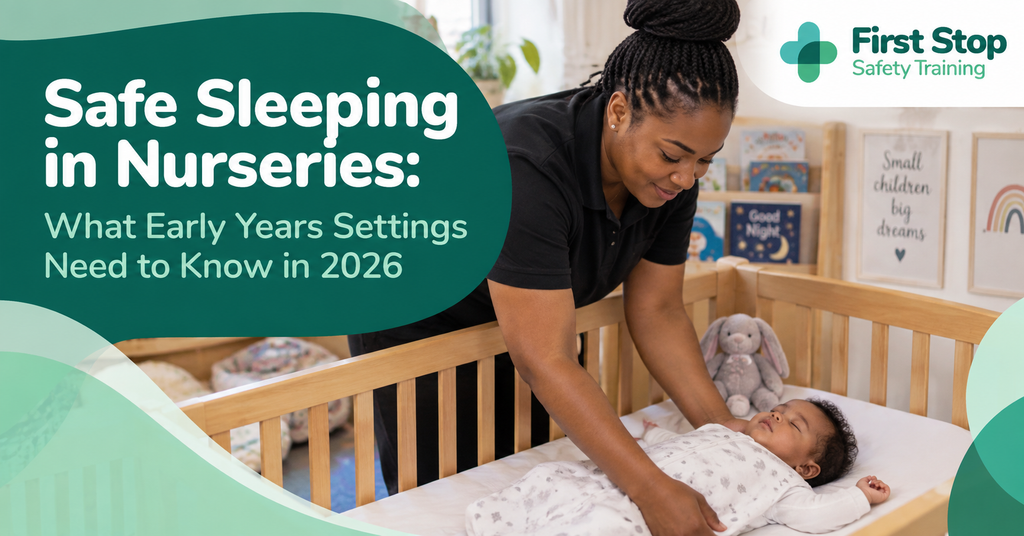
Sleep is a normal and essential part of a baby’s day. For Early Years practitioners, however, putting a baby down for a nap is also a significant safeguarding responsibility.
Babies may spend several hours sleeping while in nursery or childcare. Staff therefore need to understand not only where and how babies should sleep, but why safer-sleep guidance exists, which practices increase risk and what their setting should have in place to ensure safe, consistent routines.
In 2026, safer sleep has received renewed attention across Early Years — particularly in England, where updated Early Years Foundation Stage (EYFS) requirements came into force on 1 September.
Whether you manage a baby room, work as an Early Years practitioner or provide childminding services, now is a good time to ask:
Are your safer-sleep arrangements as strong in practice as they are on paper?
Why Is Safer Sleep So Important?
Safer-sleep guidance aims to reduce the risk of sudden infant death syndrome (SIDS) and other sleep-related incidents.
SIDS is the sudden and unexpected death of a baby where no cause can be identified. While SIDS is uncommon, research has identified practices that can significantly reduce risk.
The Lullaby Trust advises that babies should be placed:
on their back, in a clear, flat, firm and separate sleep space.
For babies under six months, the safest arrangement is for the baby to sleep in the same room as their carer. The sleep space should be clear of unnecessary items and babies should not become too hot. The Lullaby Trust recommends a room temperature of around 16–20°C.
Practitioners can access detailed evidence-based guidance through The Lullaby Trust’s safer sleep advice.
What Changed in the EYFS in September 2026?
For Early Years providers in England, safer sleep became even more prominent from 1 September 2026.
The updated EYFS framework now contains explicit safer-sleep requirements within the statutory framework itself rather than directing providers elsewhere for this information. The Department for Education says this was intended to strengthen safeguarding arrangements for babies and young children.
One particularly important requirement concerns babies aged 12 months and under.
The Department for Education’s current guidance states that these babies must sleep in an appropriate cot — defined for these purposes as a cot, carrycot, Moses basket or travel cot. Floor beds, coracles and sleep pods do not meet the EYFS requirement for babies of this age.
The guidance also says that if a baby falls asleep while travelling, they should be transferred to their appropriate sleep space once they return to the setting.
For English providers, safer sleep is also now more visible during inspection. Ofsted confirmed that, from September 2026, inspectors will consider whether settings understand and effectively implement the statutory requirements for babies’ sleeping arrangements.
Providers in England should read the current Department for Education safer-sleep guidance for Early Years settings alongside the current EYFS framework.
What About Nurseries in Scotland?
The EYFS applies in England, so those specific statutory changes do not apply to Scottish nurseries.
However, safer sleep remains an important part of safe childcare practice in Scotland.
The Scottish Government and NHS Scotland publish dedicated safer-sleep guidance, developed with organisations including The Lullaby Trust, UNICEF Baby Friendly Initiative and the Baby Sleep Information Source.
Scottish guidance reinforces the key messages of placing babies on their backs for every sleep, providing a clear, flat and separate sleep space, keeping babies smoke-free and ensuring babies have an alert carer able to respond to their needs.
Scottish Early Years practitioners and managers can access the Scottish Government’s Safer Sleep for Babies resources.
The Care Inspectorate also signposts the national safer-sleep guidance within its resources for childcare services.
What Does a Safer Sleep Space Look Like?
A sleep environment does not need lots of specialist equipment.
In fact, simpler is generally safer.
For babies, a suitable sleep space should have a firm, flat mattress with a waterproof cover and should remain clear of objects that could obstruct breathing or cause overheating.
The Lullaby Trust advises against placing unnecessary items in a baby’s cot, including:
- pillows and duvets
- cot bumpers
- soft toys and comforters
- weighted or bulky bedding
- sleep positioners, wedges and straps
- pods or nests
- rolled towels or other soft items placed on the mattress.
Babies should initially be placed on their backs for every sleep. Once a baby is able to roll from their back to their front and back again independently, they can find their own sleep position, although practitioners should continue placing them down on their back initially.
What About Bouncers, Pushchairs and Car Seats?
This is an area worth discussing with the whole team because babies sometimes fall asleep somewhere that was not intended as their sleep space.
A baby falling asleep does not automatically make the place they have fallen asleep a safe place for prolonged sleep.
The Lullaby Trust advises against routinely sleeping babies in bouncy chairs, beanbags, sofas, pods, nests or car seats, and advises against babies sleeping in seated or inclined positions such as pushchairs or buggies.
Where a baby falls asleep in one of these products, Early Years practitioners should follow current guidance and their setting procedures for moving the baby to an appropriate clear, firm and flat sleep surface.
Monitoring Sleeping Babies
Safer sleep is not only about the cot.
It is also about what practitioners do while the child is sleeping.
Nurseries should have clear procedures around supervision and monitoring, including who is responsible, how checks are conducted, how information is recorded and what staff should do if they notice anything concerning.
Managers should consider questions such as:
Can sleeping babies be appropriately observed?
Does every member of baby-room staff understand the setting’s sleep procedure?
Are sleep checks carried out consistently rather than becoming a routine tick-box exercise?
Would a temporary or newly recruited member of staff know what is expected?
Do staff know what action to take if a baby appears unwell or is breathing abnormally?
Consistency matters. A safer-sleep policy offers little protection if individual practitioners follow different routines.
Working With Parents and Carers
Sleep can sometimes be a sensitive area because families understandably have their own routines and preferences.
Good partnership working means listening to parents while also being clear about the setting’s professional responsibilities.
For example, a parent may explain that their baby normally sleeps in a particular position or uses an item at home. Practitioners need to know when a parent’s preference can be accommodated and when current safer-sleep guidance or statutory requirements mean the setting must follow a different approach.
The Lullaby Trust has developed a particularly useful safer sleep checklist for families choosing childcare, including questions parents can ask nurseries and childminders about sleep spaces, policies and staff training.
Settings may find it useful to share or review this with their teams:
Safer sleep in childcare: checklist for families
Is Your Safer-Sleep Policy Actually Reflected in Practice?
Having a policy is important, but managers should periodically compare that policy with what actually happens in the baby room.
A useful review could look at:
- where babies currently sleep
- condition and suitability of mattresses
- what is present inside cots
- sleep positioning
- room temperature
- supervision and monitoring arrangements
- recording of sleep checks
- staff understanding of unsafe sleep products
- communication with parents
- arrangements for babies who fall asleep while travelling
- induction of new, agency or temporary staff
- whether current guidance has changed since the policy was written.
The Lullaby Trust’s Early Years Hub contains practical resources specifically for childcare settings, including safer-sleep guidance, posters, a setting audit tool and resources for families.
Explore The Lullaby Trust Early Years safer-sleep resources
Safe Sleeping Training for Early Years Practitioners
Safe practice depends on staff understanding why procedures exist rather than simply being told what to do.
First Stop Safety Training’s Safe Sleeping online course has been developed specifically for Early Years professionals working with babies and young children.
The course covers safer-sleep risks and hazards, positioning, sleep environments, mattress and cot safety, overheating, sleep monitoring, supervision, recording, communication with families and safer-sleep policies.
It uses practical activities and scenarios to help practitioners apply guidance to situations they may encounter in real Early Years settings.
The course takes approximately 1–1.5 hours, includes a final assessment and provides a downloadable certificate following successful completion.
Take the Safe Sleeping online CPD course
Train Your Whole Nursery Team Through the First Stop Learning Hub
Safe Sleeping is also included within the First Stop Learning Hub, alongside a growing library of CPD-accredited Early Years courses covering safeguarding, health and safety, child development, infection control, medication, choking, allergies, behaviour and professional practice.
For managers who want one place to organise staff development, the Hub includes unlimited staff access, manager reporting, downloadable certificates and new courses added throughout the year.
You can read more about what’s included in the First Stop Early Years Learning Hub.
Settings can currently start with a 90-day free trial before the annual subscription begins.
Start your First Stop Learning Hub 90-day free trial
Safer Sleep Is Everyday Safeguarding
Most safer-sleep practice happens during very ordinary moments.
A practitioner puts a tired baby down after lunch.
A baby falls asleep unexpectedly in a pushchair.
A new staff member covers the baby room.
A parent asks for a familiar comfort item to be placed in a cot.
Someone notices that a room feels warmer than usual.
These may seem like small decisions, but safe childcare is built from consistent everyday decisions made by practitioners who understand the risks.
Policies, equipment and recording systems all matter. But ultimately it is knowledgeable, attentive staff who put safer-sleep guidance into practice.
For Early Years settings, the goal should not simply be to say “we have a safer-sleep policy.”
It should be to know that every member of the team understands it and follows it whenever a child is put down to sleep.