
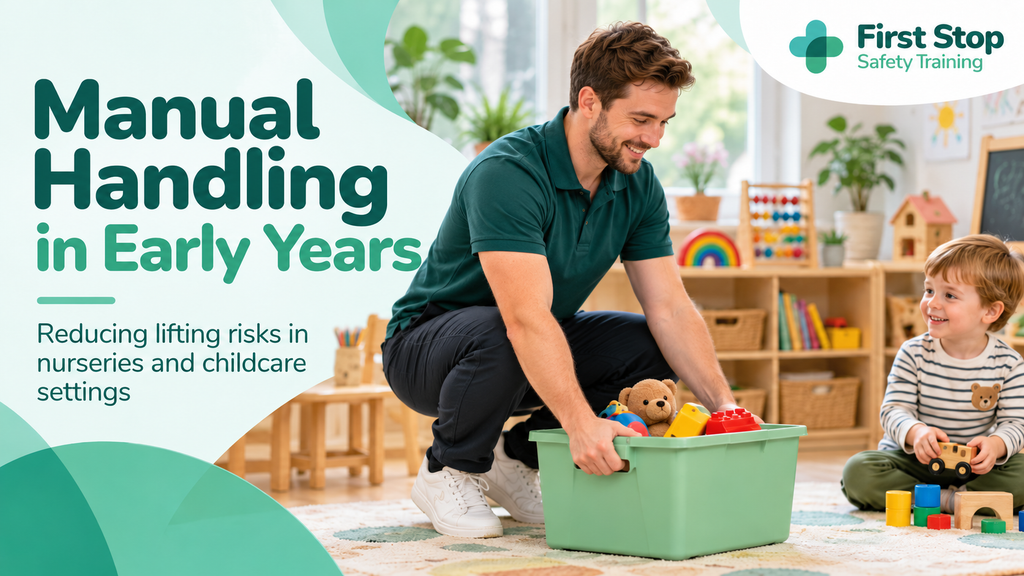
Working in Early Years can be surprisingly physical.
Throughout a normal day, practitioners may lift or support children, move tables and chairs, carry play equipment, set up outdoor areas, push loaded trolleys, work at floor level and repeatedly bend down to children’s height.
Individually, many of these tasks may appear harmless.
But when they are repeated throughout a shift, particularly when combined with awkward postures or poor lifting habits, they can place considerable strain on the body.
This is why manual handling in Early Years settings should be treated as an important part of staff health, safety and wellbeing.
Manual handling training isn’t simply about teaching people how to pick up a box correctly. In a nursery or childcare environment, good manual handling practice is about looking at how work is organised, whether a task really needs to be carried out in that way, the environment practitioners are working in and how unnecessary lifting can be reduced.
In this guide, we look at some of the most common manual handling risks in Early Years and practical steps settings can take to protect their teams.
What Does Manual Handling Mean?
Manual handling is broader than many people realise.
The Health and Safety Executive (HSE) defines manual handling as transporting or supporting a load by hand or bodily force.
That includes:
- lifting
- lowering
- carrying
- pushing
- pulling
- moving
- supporting
Importantly for Early Years settings, a load does not have to be an object.
It can also be a person.
That means lifting or supporting a child can fall within manual handling just as moving a box of resources can.
Examples of manual handling in a nursery might include:
- lifting a child onto a changing table
- helping a child into a highchair
- supporting a child who has fallen
- carrying sleeping children
- moving tables and chairs
- carrying boxes of toys or resources
- moving outdoor play equipment
- lifting bedding or sleep equipment
- carrying deliveries
- pushing storage units or trolleys
- setting up or packing away play areas
Manual handling is therefore not an occasional task in Early Years.
For many practitioners, it happens dozens of times during an ordinary working day.
Why Are Early Years Practitioners at Risk of Manual Handling Injuries?
Early Years environments are designed around children rather than adults.
That creates some unique challenges for practitioners.
Think about how often Early Years staff:
- sit on very small chairs
- kneel on the floor
- bend over low tables
- reach into cots
- work at low changing or play levels
- pick children up from the floor
- twist while supporting a child
- move equipment around busy rooms
The risk isn’t necessarily one extremely heavy lift.
It can be the cumulative effect of repetitive movements and awkward postures.
Musculoskeletal disorders can affect the back, neck, shoulders, joints and limbs. HSE guidance identifies heavy manual work, repetitive handling and awkward postures among the factors that can contribute to these conditions.
This is why a practitioner saying:
“I’ve lifted children like this for years and I’ve never hurt myself.”
doesn’t necessarily mean the practice is safe.
Some injuries happen suddenly, but others build gradually.
A slight ache at the end of a shift can eventually become a more persistent problem if the cause isn’t identified and addressed.
Manual Handling Is About More Than “Lift With Your Knees”
Traditional manual handling training sometimes becomes reduced to one message:
Bend your knees and keep your back straight.
Real risk management is much broader than that.
HSE guidance says employers should first try to avoid hazardous manual handling where reasonably practicable.
If the task cannot be avoided, the risk should be assessed.
The next step is to reduce the risk of injury as far as reasonably practicable.
In other words, before teaching someone how to lift something, it is worth asking:
Does this actually need to be lifted at all?
That question is particularly useful in Early Years.
Could the Child Do More Independently?
One of the most effective ways to reduce unnecessary manual handling in Early Years is often also good childcare practice:
supporting children’s independence.
Imagine a practitioner changing ten children during a session.
If every child is automatically lifted onto a changing station, that can involve a significant amount of lifting over the course of a week.
For children who are developmentally able to do so safely, could steps be used so they can climb onto an appropriate changing area themselves?
The same principle might apply when children:
- get into chairs
- climb onto appropriate changing facilities
- put away resources
- collect belongings
- move between areas
- access play equipment
Of course, age, ability, supervision and individual needs must always be considered.
The answer isn’t simply “never lift children”.
But avoiding unnecessary lifting can protect practitioners while also helping children develop confidence and independence.
Lifting and Supporting Children Safely
There will always be situations where practitioners need to lift or support a child.
Before doing so, consider the situation rather than lifting automatically.
Ask yourself:
- Does the child actually need to be lifted?
- Can they move independently with support?
- Am I in a stable position?
- Can I get close to the child?
- Is there enough space around me?
- Am I likely to need assistance?
- Is the child likely to move suddenly?
- Where am I moving them to?
Children are particularly challenging loads because they are not static objects.
A box does not suddenly lean backwards, wriggle, grab hold of something or change its weight distribution.
A child can.
This unpredictability needs to be considered when assessing the task.
Where lifting is necessary, general safer handling principles include getting close to the load, adopting a stable position, avoiding unnecessary twisting and moving smoothly rather than jerking or snatching.
Avoid Lifting and Twisting at the Same Time
One common manual handling habit is lifting something while simultaneously turning the upper body.
For example, imagine picking up a child from the floor and immediately twisting sideways to place them onto a changing surface.
That combination can place additional strain on the body.
A better approach is generally to:
- establish a stable position
- bring the load close
- lift smoothly
- move your feet to turn
- face the direction you are moving towards
HSE guidance specifically recommends moving the feet rather than twisting the back while handling a load.
It sounds simple, but it is exactly the type of small movement pattern that can become habitual in a busy nursery.
Think About Your Environment
Sometimes the problem isn’t the practitioner.
It’s the workspace.
Imagine trying to lift a box of resources when:
- toys are scattered across the floor
- another box is blocking the cupboard
- the shelf is above shoulder height
- there isn’t enough room to stand properly
- you have to twist around furniture
Even relatively light objects can become more difficult to handle when the environment makes the task awkward.
Settings should therefore consider:
- how frequently used resources are stored
- whether heavy items are stored at sensible heights
- whether walkways are clear
- whether equipment can be accessed without excessive reaching
- whether furniture needs to be moved regularly
- whether storage systems could be improved
- whether wheeled equipment or handling aids could reduce carrying
Sometimes a relatively small environmental change can remove hundreds of unnecessary awkward movements over the course of a year.
Low-Level Working Is an Early Years Issue Too
Manual handling isn’t only about lifting.
Working posture matters.
Early Years practitioners spend a significant amount of time at children’s level.
That may involve:
- sitting on the floor
- crouching
- kneeling
- leaning across low tables
- sitting on child-sized furniture
- bending during play activities
- leaning over cots or changing areas
Occasionally doing these things may not create a significant problem.
The concern comes when awkward positions are held for long periods or repeated throughout the day.
Teams should think about whether their environment provides opportunities for practitioners to vary their posture.
For example:
Could an adult-sized chair be available in each room?
Could some activities be brought to a more comfortable height?
Can practitioners change position regularly rather than remaining on the floor for extended periods?
Are staff repeatedly leaning across furniture when the layout could simply be changed?
Manual handling risk reduction often comes from looking at the whole working day, not just individual lifting tasks.
Think Before You Move Heavy Equipment
Nurseries regularly rearrange environments.
Tables are moved.
Outdoor resources are carried outside.
Play equipment is set up.
Storage boxes are shifted.
Rooms are transformed for different activities.
Before moving something, practitioners should ask:
- How heavy is it?
- Is it bulky or difficult to grip?
- Where is it going?
- Is the route clear?
- Can it be dismantled?
- Can it be pushed safely rather than carried?
- Is there appropriate equipment available?
- Should two people move it?
- Does it need to be moved at all?
One of the most useful manual handling habits is simply planning the task before starting it.
HSE guidance recommends considering where a load is going, removing obstructions, using suitable handling aids where possible and getting help where needed.
Is There a Maximum Weight Staff Are Allowed to Lift?
This is a common question.
There is no single legal maximum weight that every employee is permitted to lift.
A weight that might present little risk in one situation could be unsafe in another.
For example, compare:
Task A: lifting a manageable box from waist height with two hands in a clear room.
with:
Task B: lifting the same box from floor level, reaching across furniture, twisting and carrying it up stairs.
The weight is identical.
The risk is not.
Risk assessment should therefore consider factors including:
- the task
- the load
- the working environment
- the frequency of handling
- the distance involved
- the posture required
- the individual’s capability
HSE guidance specifically advises considering the task, load, working environment and individual capability when assessing manual handling that cannot be avoided.
Individual Capability Matters
Not every practitioner faces exactly the same risk.
Factors such as:
- previous injuries
- existing musculoskeletal problems
- pregnancy
- temporary injuries
- physical capability
- fatigue
may affect how safely someone can carry out a task.
This is another reason why a blanket instruction such as:
“Everyone moves the tables at the end of the day”
may need more thought.
Managers should create an environment where practitioners feel able to report discomfort or difficulty early.
Waiting until someone is seriously injured is not effective risk management.
HSE guidance highlights the importance of workers reporting signs and symptoms early so action can be taken before problems become more serious.
A Quick Manual Handling Audit for Early Years Managers
Try walking through your setting and looking at it purely from a manual handling perspective.
Ask yourself:
Children
Are staff routinely lifting children who could safely move more independently?
Changing
Do practitioners repeatedly lift children onto changing surfaces?
Could suitable steps or other arrangements reduce unnecessary lifting where developmentally appropriate?
Storage
Are heavy or frequently used resources stored at sensible heights?
Floors
Do practitioners spend long periods sitting, kneeling or bending at floor level?
Furniture
How often are tables, chairs and room furniture moved?
Outdoor Play
Are staff carrying bulky outdoor equipment unnecessarily?
Deliveries
Where are deliveries placed, and how far do staff then need to move them?
Sleep Areas
Are practitioners having to stretch or lean excessively when working around cots or sleep equipment?
Team Culture
Do staff ask for help when something is awkward or heavy, or is there an expectation that they should simply manage?
A ten-minute walk through your setting can reveal manual handling issues that have gradually become “just the way we do things”.
Manual Handling Training Should Be Relevant to Early Years
Generic manual handling principles are important, but training is much more useful when practitioners can relate it to their actual work.
An Early Years practitioner isn’t working in a warehouse.
Their questions are more likely to be:
Should I pick up a child who is having a tantrum?
How can we reduce lifting during nappy changing?
How do I safely work at floor level all day?
What if a child suddenly moves while I am supporting them?
Should one person move this play equipment?
Could we change the environment so staff don’t have to keep lifting this?
This is why manual handling training designed specifically for nurseries and childcare settings can be more useful than generic workplace examples.
It encourages practitioners to recognise the risks hidden within ordinary Early Years routines.
Manual Handling Training for Early Years Practitioners
Our Manual Handling for Early Years Practitioners online course has been developed specifically for people working in nursery, childcare and Early Learning and Childcare environments.
The course explores manual handling through realistic Early Years situations rather than generic workplace examples.
Learners explore:
- what manual handling means in an Early Years setting
- why practitioners may be at increased risk of injury
- how manual handling injuries can develop
- assessing tasks before handling
- safer lifting and handling principles
- supporting children’s independence
- reducing unnecessary lifting
- safer low-level working
- environmental adjustments
- staff wellbeing and injury prevention
The course takes approximately 1 hour to complete and is CPD Group accredited for 1 CPD credit.
It is suitable for practitioners, nursery staff, childminders, room leaders, managers and other professionals working within Early Years environments.
View the Manual Handling for Early Years course →
Manual Handling Training for Your Whole Early Years Team
Manual Handling for Early Years is also included in the First Stop Learning Hub.
The Learning Hub gives Early Years settings access to our growing library of online CPD training through one platform.
Courses cover areas including:
- health and safety
- safeguarding
- infection control
- fire safety
- COSHH
- food hygiene
- behaviour and co-regulation
- additional support needs
- child development
- leadership and management
This allows settings to build ongoing staff development rather than purchasing training one course at a time.
You can read more about the platform in our guide to the First Stop CPD Hub for Early Years professionals.
Settings can also explore the Hub through our 90-day free trial.
Explore the First Stop Learning Hub →
Frequently Asked Questions About Manual Handling in Early Years
What is manual handling in a nursery?
Manual handling includes lifting, lowering, carrying, pushing, pulling, moving or supporting a load. In an Early Years setting, this can include both equipment and children.
Is lifting children classed as manual handling?
Yes. Manual handling legislation and guidance can apply to moving or supporting people as well as objects.
Early Years settings should therefore consider how and when staff lift or support children and whether unnecessary lifting can be reduced.
Is there a maximum weight nursery staff can lift?
There is no universal legal maximum lifting weight.
Risk depends on the overall task, including the load, frequency, posture, environment and individual carrying out the activity.
Do nursery staff need manual handling training?
Employers have duties to protect workers from manual handling risks.
Training can form part of managing those risks, but training alone is not enough.
Employers should first look at whether hazardous manual handling can be avoided and, where it cannot, assess the risk and reduce it as far as reasonably practicable.
Should nursery staff lift children onto changing tables?
Where a child genuinely needs to be lifted, the task should be carried out safely.
However, for children who are developmentally capable and where suitable equipment is available, encouraging them to climb safely onto an appropriate changing facility may help reduce unnecessary lifting while supporting independence.
Any approach should take account of the individual child’s age, development and needs.
Does manual handling only cause back injuries?
No.
Poor manual handling and awkward working practices can contribute to musculoskeletal problems affecting areas including the back, neck, shoulders, joints and limbs.
How often should manual handling training be refreshed?
There isn’t one universal refresher period that applies to every Early Years setting.
Training and risk assessments should be reviewed when circumstances change, new equipment or working practices are introduced, staff identify difficulties, incidents occur or managers believe knowledge needs refreshing.
The important point is that manual handling remains part of ongoing health and safety management, rather than being treated as a one-off training exercise.
Safer Manual Handling Starts With Everyday Decisions
Manual handling injuries are not always caused by one dramatic event.
Often, it is the repeated everyday tasks that matter.
Picking up a child.
Moving a table.
Leaning into a cot.
Sitting awkwardly on the floor.
Carrying a box of resources.
None of these activities necessarily looks dangerous.
But repeated hundreds or thousands of times, poor working practices can take their toll.
For Early Years settings, effective manual handling isn’t about telling practitioners to “lift properly”.
It is about creating an environment where teams routinely ask:
Can we avoid this lift?
Can we change the task?
Can the child participate more independently?
Can we improve the environment?
Do I need help?
Is there a safer way of doing this?
Those small decisions are what turn manual handling training into safer everyday practice.
For practitioners who want to strengthen their knowledge, our Manual Handling for Early Years Practitioners course provides practical, CPD-accredited training designed specifically around the realities of working in Early Years.
For settings looking for wider staff development, Manual Handling is also included within the First Stop Learning Hub alongside our wider library of Early Years CPD training.