
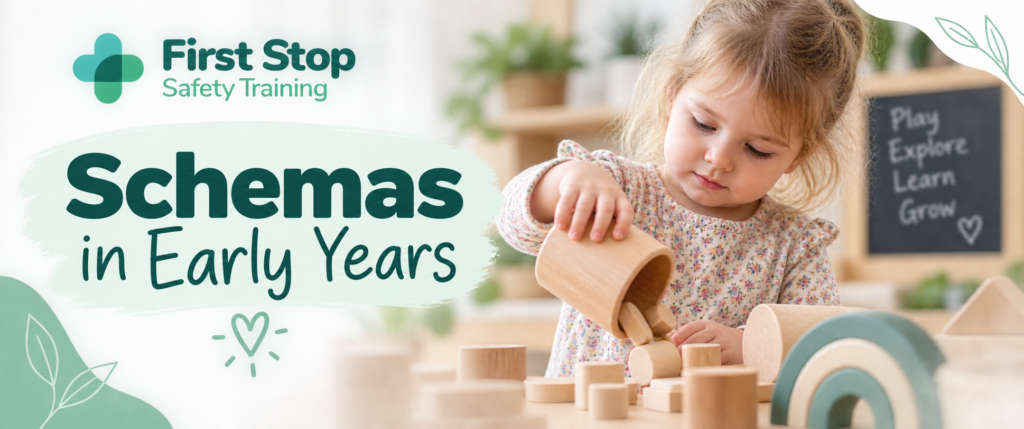
Have you ever noticed a child who repeatedly fills and empties containers, carries objects around the nursery, spins wheels, lines up toys or wraps everything they can find in blankets?
These repeated patterns may be more than simply favourite activities. They can be examples of schemas in Early Years – recurring patterns of play that can help children explore ideas and make sense of the world around them.
What Are Schemas in Early Years?
Schemas are repeated patterns of behaviour or play. A child may explore the same idea in lots of different ways and across different areas of their environment.
For example, a child exploring a transporting schema might carry blocks across the room, fill bags with toys, move sand between containers or push objects around in a trolley.
Other commonly recognised schemas include trajectory, rotation, enclosing, enveloping, positioning, connecting and orientation.
Want to explore these patterns in more detail? Our Introduction to Schemas in Early Years course explores eight commonly recognised schemas and how they can appear in everyday play.
Explore our Introduction to Schemas in Early Years course
Why Is Understanding Schematic Play Important?
Recognising schematic play can help Early Years practitioners look beyond the behaviour they initially see.
A child repeatedly moving resources around the playroom could appear to be making a mess. A child continually throwing objects might seem disruptive.
Understanding schemas encourages us to become curious instead:
What is this child exploring?
When practitioners notice patterns over time, they can provide resources, environments and opportunities that allow children to explore their interests safely and extend their learning.
Across the UK, Early Years practice places strong emphasis on learning through play, observation, children’s interests and providing opportunities for children to explore and develop. For example, England’s current Early Years guidance emphasises children’s natural curiosity, self-initiated play and the importance of open-ended resources.
For further reading on schematic play, Early Years Scotland’s schematic play resources provide useful professional learning around recognising schemas and using observation and planning to support children’s play.
Supporting Schemas in Early Years
Supporting schematic play doesn’t mean turning every schema into an adult-led activity.
Instead, practitioners can observe, notice patterns and respond thoughtfully.
A child interested in transporting might benefit from baskets, bags and containers. A child exploring rotation could investigate wheels, spinning objects and circular movement.
If a child’s exploration becomes unsafe – such as throwing inappropriate objects – understanding the possible schema can help us provide a safer way for them to explore the same idea.
Most importantly, schemas should help us understand children’s play rather than become labels we attach to children.
Learn More About Schemas in Early Years
Our Introduction to Schemas in Early Years online course explores eight commonly recognised schemas, how to identify patterns through observation and practical ways to support schematic play in your setting.
The course is also available as part of the First Stop Learning Hub, giving Early Years settings access to our growing library of online CPD training.
Sometimes the play that looks most repetitive to an adult is where some of a child’s most interesting exploration is happening.
Observe. Notice the pattern. Then ask: what might this child be exploring?