New allergy safety requirements are changing how schools in England manage allergies and anaphylaxis. Is your school ready?
Following the campaign for Benedict’s Law, allergy safety has now been placed on a much stronger statutory footing through the Children’s Wellbeing and Schools Act 2026.
The Department for Education has also published new statutory Allergy Safety in Schools guidance, setting out what schools must do to support pupils with allergies.
For schools, this is a significant change.
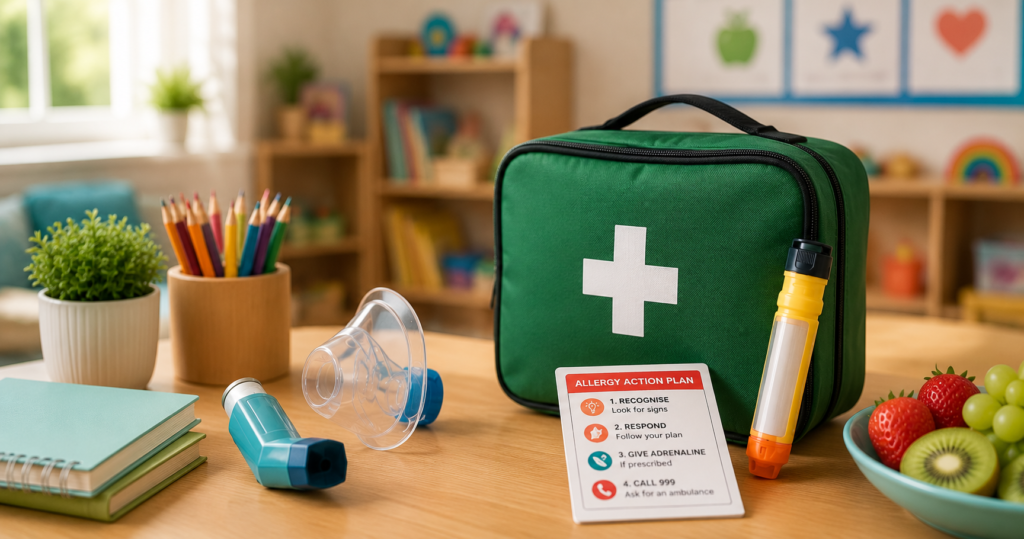
Allergy safety can no longer be treated simply as information held by the first aider, school office or a child’s class teacher.
The new approach is about making allergy safety a whole-school responsibility.
And with the 2026/27 academic year about to begin, now is the time for schools to review whether their policies, training and everyday practice are ready.
What is Benedict’s Law?
Benedict’s Law is the name associated with the campaign led following the death of five-year-old Benedict Blythe, who died after experiencing an allergic reaction at school. The campaign called for stronger and more consistent allergy protections for children in schools. Those concerns have now resulted in major changes to allergy safety in England.
Section 34 of the Children’s Wellbeing and Schools Act 2026 requires local-authority-maintained schools, academies and pupil referral units to have an allergy safety policy.
The Government has also introduced statutory allergy safety guidance covering areas including policies, staff training, Individual Healthcare Plans and learning from serious incidents and near misses.
This represents an important shift from allergy safety being treated primarily as guidance and good practice towards much clearer statutory expectations.
What do the new allergy safety requirements mean for schools?
The new DfE statutory guidance is particularly important because it doesn’t focus solely on what happens after a child experiences an allergic reaction.
Schools need systems designed to prevent incidents, prepare staff and ensure children with allergies can participate safely in school life.
The guidance covers four particularly important areas:
Allergy safety policies – schools need a clear, published approach to managing allergies.
Staff allergy training – allergy safety training needs to be in place for staff.
Individual Healthcare Plans – schools need to identify children and young people who require an IHP to manage their allergy and put appropriate plans in place.
Incidents and near misses – serious incidents and near misses should be recorded and used as opportunities to learn and improve practice.
This is not simply about producing another policy document. The real test is whether those arrangements actually work when a child needs them.
Does every member of school staff need allergy awareness?
This is one of the biggest changes schools need to understand.
Allergy safety isn’t relevant only to teachers or qualified first aiders.
A serious allergic reaction could happen in the classroom, playground, dining hall, breakfast club, after-school club, sports field, school bus or during a school trip.
The adult nearby could be a teacher but they could equally be a teaching assistant, lunchtime supervisor, caretaker, member of the catering team or another member of the school workforce.
The Government has specifically highlighted allergy awareness training for all staff, including recognition of symptoms, emergency response and the use of adrenaline devices. That makes whole-school awareness particularly important.
Would your staff recognise anaphylaxis?
Anaphylaxis is a severe allergic reaction that can develop rapidly. Staff therefore need to understand more than simply which children have allergies.
They need to know how an allergic reaction may present, when symptoms could indicate anaphylaxis, where emergency medication can be accessed and what their school’s emergency arrangements require them to do. They should also understand why prompt adrenaline and emergency assistance matter. And prevention is just as important.
Consider what happens in your school when:
- a child is given food or a snack;
- somebody brings homemade cakes into school;
- pupils share food or drinks;
- a class completes a cooking activity;
- a child attends breakfast or after-school club;
- a supply teacher takes over a class;
- a pupil goes on a school trip; or
- a child tells an adult, “My mouth feels funny.”
Good allergy management has to work in all of those situations — not just during a planned first-aid scenario.
Allergy Action Plans and Individual Healthcare Plans need to work in practice
Having the correct paperwork is important.
But consider this question:
Could the person caring for the child actually access the information they needed when they needed it?
An excellent Allergy Action Plan is of limited use during an emergency if nobody knows where it is.
Similarly, prescribed emergency medication needs to be accessible when required.
Schools should think carefully about how information moves between teachers, support staff, catering teams, temporary staff, clubs, trips and anyone else who may be responsible for a pupil.
Parents and carers are also an essential source of information about their child’s allergies, previous reactions, prescribed medication and individual needs.
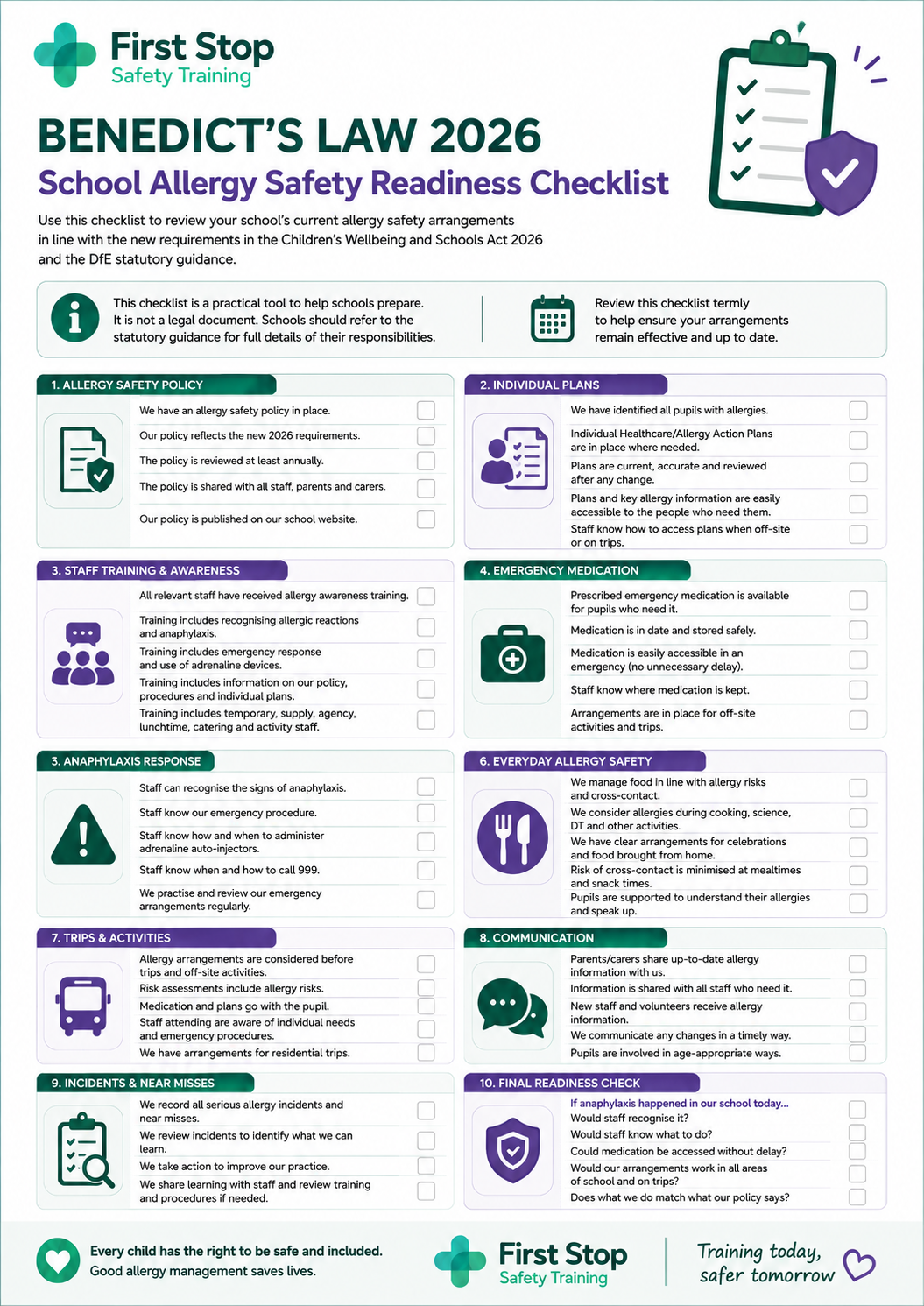
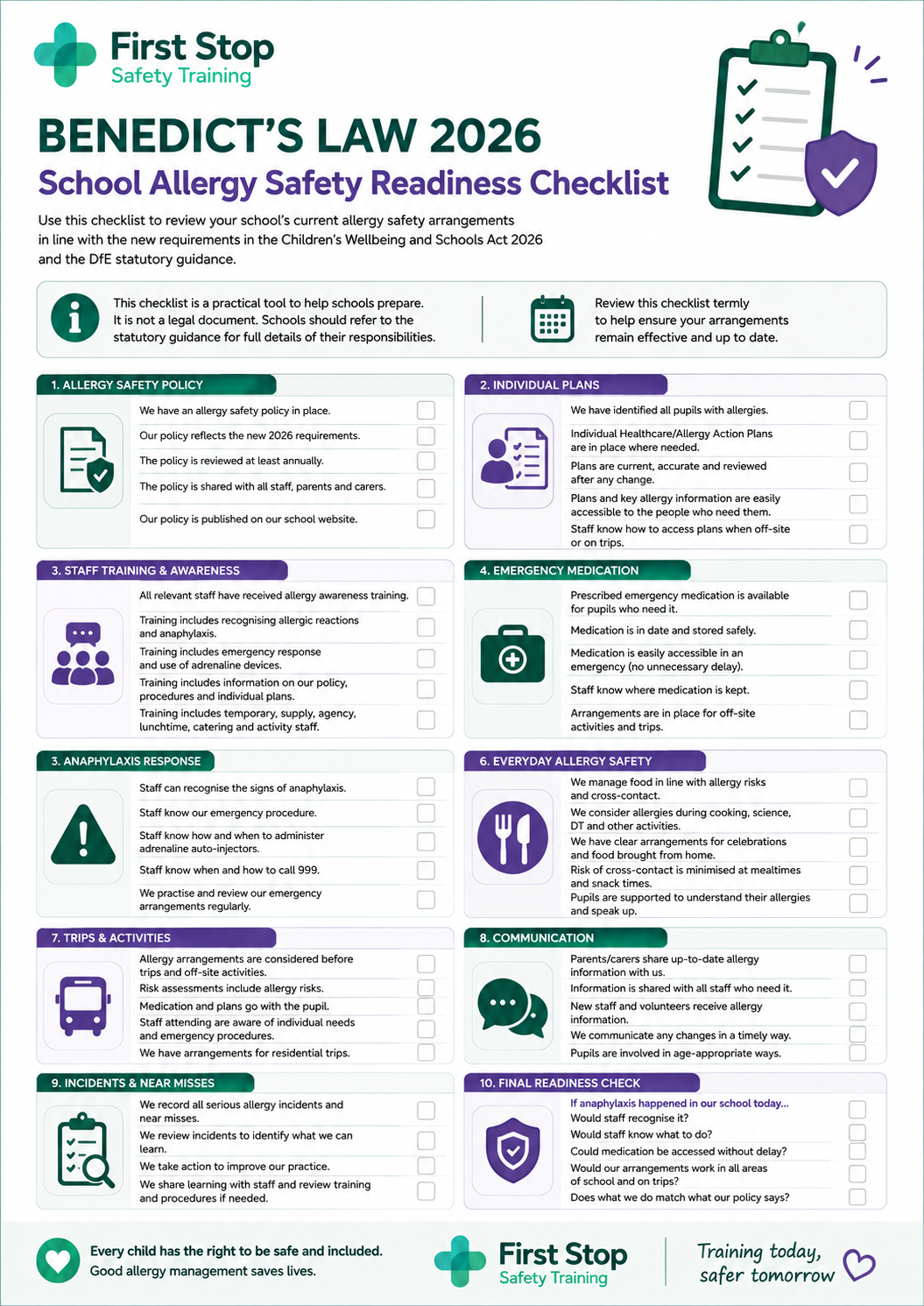
FREE DOWNLOAD: Is Your School Ready for Benedict’s Law?
We’ve created a free Benedict’s Law School Allergy Safety Readiness Checklist to help schools review their current arrangements.
It takes only a few minutes to work through and covers:
✔ Allergy policies and planning
✔ Individual Healthcare Plans
✔ Staff training and awareness
✔ Emergency medication
✔ Anaphylaxis response
✔ Everyday food and activity risks
✔ Communication with staff and families
✔ Trips and off-site activities
✔ Serious incidents and near misses
✔ Reviewing whether written policy matches everyday practice
Download your FREE Benedict’s Law School Readiness Checklist
No course purchase required.
The question every school should ask before September
There’s a simple way to test whether allergy arrangements are working.
Ask:
If a pupil experienced anaphylaxis in our school tomorrow, would the adults around them know what to do?
Then go further.
Would they recognise it?
Would they know the child’s individual needs?
Could they access the child’s emergency medication?
Would a lunchtime supervisor know?
Would a supply teacher know?
Would the same arrangements work on a school trip?
And does what actually happens in your school match what your allergy policy says should happen?
If any of those questions cause uncertainty, there may be a gap worth addressing.
New Allergy Awareness & Anaphylaxis Training for Education Settings
To help education settings prepare, First Stop Safety Training has developed a new Allergy Awareness & Anaphylaxis in Education Settings online course.
This isn’t an old allergy course with a new title.
The training has been developed in 2026 to reflect the latest allergy safety requirements and statutory guidance, including the changes associated with Benedict’s Law.
It combines the legal and professional responsibilities with the practical situations staff are likely to encounter during an ordinary school day.
What does the course cover?
Learners explore:
✔ Understanding allergies and anaphylaxis
✔ Common allergens and hidden risks
✔ Preventing accidental exposure
✔ Cross-contact and food safety
✔ Recognising allergic reactions
✔ Recognising anaphylaxis
✔ Responding appropriately in an emergency
✔ Prescribed emergency medication and adrenaline devices
✔ Allergy Action Plans and Individual Healthcare Plans
✔ Working with parents and carers
✔ Communicating allergy information between staff
✔ Supporting children to understand and speak up about their allergies
✔ Meals, celebrations, activities and school trips
✔ Creating inclusive environments for children with allergies
✔ Allergy policies, legislation and current guidance
✔ Learning from incidents and near misses
And rather than simply clicking through pages of text, learners work through realistic scenarios, case studies, interactive learning activities and reflection exercises.
Who is the course for?
One of the most important messages behind the new approach is that allergy safety isn’t solely the responsibility of the first aider.
The course is suitable for people working with or responsible for children and young people, including:
Teachers • Teaching assistants • Early Years practitioners • Nursery staff • Lunchtime supervisors • Catering teams • Wraparound-care staff • Support staff • School office staff • Supply and temporary staff • Activity leaders • School transport staff and others supporting children
That makes it particularly suitable for settings looking for whole-team allergy awareness training.
How long does the training take?
The online course takes approximately two hours to complete.
Learners can complete it online at a time that suits them and work through the course at their own pace.
At the end there is a 10-question final assessment with an 80% pass mark.
Successful learners receive a First Stop Safety Training certificate of completion, which can be retained as evidence of staff training and approximately 2 hours of structured CPD learning.
Why choose training that’s been updated for 2026?
There is plenty of allergy information available online.
But if a school is investing staff time in training, it makes sense to use training that reflects the environment staff are actually working in now.
The legal and statutory landscape for allergy safety in England has changed.
The Children’s Wellbeing and Schools Act 2026 is now law, Section 34 specifically addresses allergy safety policies, and the DfE has published statutory guidance explaining what schools must do to support pupils with allergies.
Our course has been built with those developments in mind. It also makes the subject practical. Because staff don’t only need to know what the guidance says.
They need to know what to do when a child is standing in front of them.
Preparing your school for the new allergy safety requirements
The start of the 2026/27 academic year provides a natural opportunity to review allergy arrangements.
Schools should be asking:
Who has allergies?
Where are their plans?
Where is their emergency medication?
Who needs to know?
What happens during meals, trips, celebrations and activities?
And what happens if anaphylaxis occurs?
If the answers aren’t immediately clear, now is the time to address them.
Make allergy safety part of everyday practice
Policies matter.
Training matters.
Individual plans matter.
But ultimately allergy safety comes down to what happens every day.
It’s the member of staff who checks before giving unfamiliar food to a child.
It’s the practitioner who listens when a child says something doesn’t feel right.
It’s making sure medication goes on the school trip.
It’s ensuring a temporary member of staff has the information they need.
And it’s having adults around a child who can recognise anaphylaxis and respond without unnecessary delay.
New laws. New statutory guidance. Is your team ready?
Enrol in Allergy Awareness & Anaphylaxis in Education Settings today and give your staff practical, up-to-date training for the changing allergy-safety requirements in education.